


Turtles from Western Greece currently treated at the Rescue Centre in Glyfada
The Sea Turtle Rescue Centre in Glyfada utilizes the work of volunteers to help rehabilitate sea turtles that are found injured on the beaches and seas of Greece. Volunteers stay for either six months through the European Voluntary Service, or independently for at least four weeks. They are also supported by volunteers who live in Athens and help us once a week on their spare time.
Most sea turtles are injured by being accidentally caught in fishing nets or on large fishing hooks. A significant number is further injured by deliberate injuries from the fishermen that catch them, and these injuries are mostly on the head. Some fishermen deliver injured sea turtles to the port police, while others put them back in the water to be found later on the nearby coasts. Those who are lucky enough are found while they are still alive and with the help of locals and the port police they are transferred to the Sea Turtle Rescue Centre in Glyfada.
Turtles that arrive at the Sea Turtle Rescue Centre are given daily treatment to heal their injuries or illness, and are kept in sea-water tanks until they are ready to safely return to the sea. This can take from a few months to several years.
Around fifty turtles arrive at the Rescue Centre every year, and about 60% of them survive and are released back into the sea. Most turtles arrive during the spring and summer; this is the time turtles come to the nesting beaches to reproduce. We receive very few turtles during the winter months, although we still receive many reports of turtles which are found dead.
All injured turtles are given a name by the people who find them or by the volunteers that receive them and attend to their treatment. Some turtles are adopted by people who wish to support our work financially; this is significant help to our difficult and expensive task, since the government and its agencies which are responsible for these animals offer very little financial help.
There are currently 15 turtles at the Sea Turtle Rescue Centre, with a variety of injuries and durations of stay. The following paragraphs are a short presentation of 7 turtles which arrived from Western Greece, written by the volunteers who treat them.
Artemis by Wilhelm Bodmark.
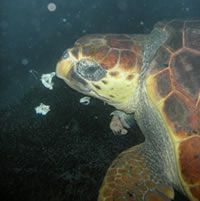
Andreas by Wilhelm Bodmark.
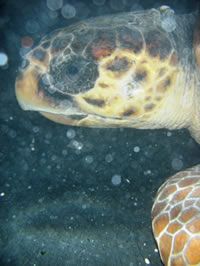
Marilena by Rebecca Langstrom.
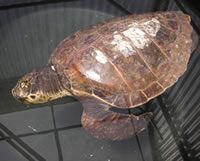
Smapo by Lindsey Death.
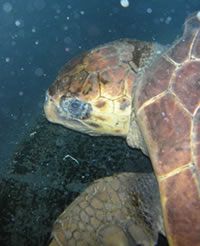
Smapo has recently started eating on his own, which is great news. He was being tube fed twice a week until we discovered that although he wouldnʼt touch fish or squid, he did have an appetite for sea urchins. This meant that someone had to regularly venture into the sea to dive for urchins for his dinner. Now he is eating fish we only fetch urchins occasionally for a treat.
Nondas by Lindsey Death.
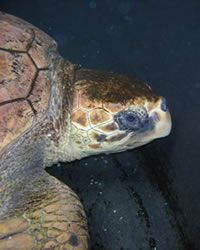
At 25kg Nondas is still a teenage turtle of unknown sex and has a distinctive colour of brown to his carapace which is much lighter than most of the other turltles. He can also be easily recognized by his flipper flapping on the side of the tank and surface of the water to attract attention.
Pelagia by Molly McCharger.
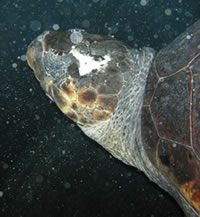
Dina by Duncan Howitt-Marshall.
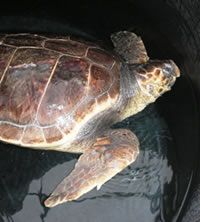
Due to the severity of her head injury she is likely to have extensive damage to the nerves and muscle tissue in her head and neck. Her head tilts to the left and her hind flippers are tightly tucked under her carapace; a sure sign of stress and discomfort. Her injury has all the hallmarks of blunt force trauma, most likely a cruel human strike. It will take a great deal of time to heal. Despite this grim prognosis, Dina is a true testament to the robust nature of these extraordinary animals. Loggerhead sea turtles have remained unchanged for approximately 40 million years. Their tough armoured exterior helps to protect them from injury from their natural enemies, but the strength of simple tools like hammers, axes, propellers, fishing gear and even shotguns in combination with human brutality are unfortunately exterminating them in unprecedented rates. We struggle daily so that Dina and the other injured turtles at the Rescue Centre may survive against the odds.
Edited and tranlsated by Nikos Vallianos with input from Wilhelm Bodmark, Rebecca Langstrom, Johannes Kupke, Lindsey Death, Ida Kotjerba, Molly McCharger, Duncan Howitt-Marshall, Pavlos Tsaros, and Nikos Vallianos.
The Sea Turtle Rescue Centre in Glyfada and the Turtles of the Aegean Sea.
EUROPEAN YEAR OF VOLUNTEERING CELEBRATION
RECENT NEWS
- OUR NEWS01/10/2026
October for sea turtles: Help us care for our sea turtle patients this winter
This October, we are launching a fundraising campaign with one clear goal: to raise €5,000 to support the care of our sea turtle patients through the end of 2026.
- OUR NEWS25/09/2026
Together for Crete’s nesting beaches: "Turtle-Friendly Hotel" award ceremonies in Chania and Rethymno
ARCHELON hosted the award ceremonies for the new Turtle-Friendly Hotel certification, as part of the TUI Turtle Aid Greece program in Crete.
- OUR NEWS23/09/2026
We bade farewell to Omiros, the blind sea turtle that traveled from Greece to Cornwall
In September 2026 Omiros, a male Loggerhead sea turtle with a remarkable story, passed away. He had spent the last 16 years of his life at the Blue Reef Aquarium in Cornwall, having traveled there from Greece.
- OUR NEWS10/09/2026
Sea turtles kept in a restaurant tank in Chania: True love for nature begins with respect.
We all feel a sense of excitement when we encounter a wild animal up close. It is only natural to want to connect with nature, observe it and understand it better.
- OUR NEWS09/09/2026
Schools are back at ARCHELON! A new year full of learning and action
The new school year is beginning, and with it, the voices, questions, and excitement of thousands of students return to ARCHELON’s Sea Turtle Rescue Centre.
- OUR NEWS06/09/2026
Sea Turtle Hatchlings Captivated All Ages in Corfu
- OUR NEWS01/09/2026
Taking time off work to volunteer for the sea turtles in Greece: Amy’s month with ARCHELON in southern Peloponnese
When Amy Carey was 10 years old, she came face to face with a sea turtle while on holiday in Greece. Decades later, at 47, she decided it was time to turn that childhood memory into reality.
- OUR NEWS13/08/2026
Hatchlings need help in September and October: Special volunteer offer for 2 weeks!
In order to protect the nests and the last hatchlings of this year, we need the help of more volunteers!
- OUR NEWS10/08/2026
One beach party canceled, 66 nests saved in Chania!
A significant victory for the protection of sea turtles in Chania, thanks to the direct cooperation of ARCHELON and NECCA.
- OUR NEWS07/08/2026
Sea turtles of the Saronic Gulf: Why feeding them is not an act of love
The Municipality of Saronikos and ARCHELON are campaigning for the safe and proper coexistence of bathers and wildlife.
- OUR NEWS05/08/2026
Greek fishermen release rare Leatherback Turtle in the North Aegean!
In mid-July, we received a video of an impressive sea turtle that had been caught in the nets of a fishing boat.
- OUR NEWS30/07/2026
Join our Sea Turtle Nest Excavations in Peloponnese and Crete
ARCHELON invites you to a unique experience of environmental education and scientific observation!
- OUR NEWS20/07/2026
43 Years of Tagging Sea Turtles in Greece Reveal Their Journeys in the Mediterranean
A new scientific publication highlights the important marine areas turtles use in the Mediterranean, through ARCHELON’s tagging program in Zakynthos, Kyparissia Bay and Rethymno.
- OUR NEWS17/07/2026
The first hatchlings of 2026 in Zakynthos!
The first nest hatched on Dafni beach in Laganas Bay in Zakynthos. Our team discovered the tiny tracks in the early hours of Tuesday, July 14th.
- OUR NEWS15/07/2026
A rare giant of the Greek seas: What our new study reveals about the Leatherback turtle
A new scientific publication brings together for the first time all available records of the Leatherback sea turtle (Dermochelys coriacea) in Greek waters.