

Fishing and strandings of sea turtles in the Bay of Kyparissia
Sea turtles constitute one of the most ancient species of fauna to still exist on Earth. The fossil archives lead to the conclusion that turtles were already around at the time of dinosaurs. Even though dinosaurs have gone extinct, turtles continue to survive to this day. However, turtles nowadays face numerous dangers from various human activities, with fishing being considered one of the most basic threats to the survival of the species.
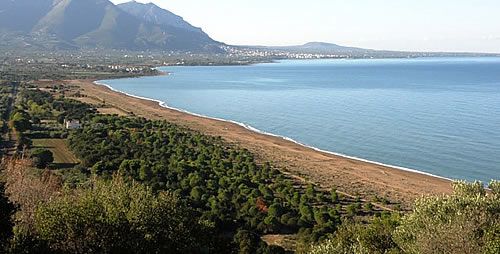
Every year in the Southern region of the Bay of Kyparissia and, since this year, with valuable help from the LIFE Euroturtles project, also in the Northern region of the Bay of Kyparissia, the researchers from ARCHELON have been recording all turtle strandings with on-site observation. Specifically for the summer period of 2017, from early May to early October, four incidents of dead turtles strandings have been recorded, in which the causes of death are connected to specific fishing activities, from fishing nets entangled on fins to longline hooks stabbed on the turtles’ bodies.
It is now important to point out that, being reptiles, sea turtles have lungs. Many times, once a turtle is somehow trapped in fishing tools, it cannot emerge to the water surface to breathe and so it dies. Their breathing frequency is connected to their activity level. A resting or sleeping turtle, for example, can stay underwater for 4 to 7 hours. However, a turtle entangled in fishing tools and consequently in a stressful situation quickly uses up the oxygen stored in its body and can drown within a few minutes.
Within the frame of the European LIFE Euroturtles project, we aim at reducing the sea turtle death rate caused by fishing tools, through actions like: informing fishermen, distributing special tools for setting trapped turtles free, cleaning abandoned fishing tools from the bottom of the sea and upgrading the rescue network and the Sea Turtle Rescue Centre in Glyfada, Attica.
The Hellenic Coast Guard as well as sensitized citizens have been a great help in ARCHELON’s efforts to record the strandings, as well as in rescuing injured turtles. Whoever spots an injured or dead turtle is kindly requested to inform local Coast Guard Authorities as well as ARCHELON so that the incident can be recorded or the turtle imminently rescued.
National Rescue Network for Sea Turtles phone number: 210 8944444, 6941511511
Giannis Chalkias, ARCHELON Peloponnese Project Assistant
Polymnia Nestoridou, ARCHELON Peloponnese Project Coordinator (tel.: 6951009785)
(translation: Betty-Maria Pagourdaki)
5th December, International Volunteer Day
Environmental education through lifelong learning at Amorgos Yperia Convention
RECENT NEWS
- OUR NEWS23/10/2026
ARCHELON's Virtual Tours Return for the 2026–2027 School Year!
A new school year filled with knowledge, creativity, and sea turtles is about to begin! Bookings for ARCHELON's virtual tours open on Monday, October 26, while the first tours will take place on Monday, November 2, 2026.
- OUR NEWS21/10/2026
Incident on Polyaigos Island: ARCHELON Calls on Authorities to Investigate the Death of a Sea Turtle
- OUR NEWS14/10/2026
The examinations behind every diagnosis: A vital step in sea turtle rehabilitation
This is where diagnostic examinations play a crucial role. X-rays are an invaluable tool for our rehabilitation team, both upon admission and throughout the recovery process, helping us determine the appropriate treatment and monitor each turtle’s progress.
- OUR NEWS09/10/2026
“Guardians of our ancient sea”: The 8th Mediterranean Conference on Marine Turtles takes place in Greece
The conference is expected to host 240 delegates from 20 Mediterranean countries, including leading researchers and scientists, as well as representatives from protected area management bodies and environmental organizations.
- OUR NEWS06/10/2026
A Wildlife Weekend at the Museum
On the weekend of October 3rd and 4th, ARCHELON participated in the "Wild Weekend", a two-day celebration dedicated to wildlife at the Goulandris Natural History Museum.
- OUR NEWS01/10/2026
October for sea turtles: Help us care for our sea turtle patients this winter
This October, we are launching a fundraising campaign with one clear goal: to raise €5,000 to support the care of our sea turtle patients through the end of 2026.
- OUR NEWS25/09/2026
Together for Crete’s nesting beaches: "Turtle-Friendly Hotel" award ceremonies in Chania and Rethymno
ARCHELON hosted the award ceremonies for the new Turtle-Friendly Hotel certification, as part of the TUI Turtle Aid Greece program in Crete.
- OUR NEWS23/09/2026
We bade farewell to Omiros, the blind sea turtle that traveled from Greece to Cornwall
In September 2026 Omiros, a male Loggerhead sea turtle with a remarkable story, passed away. He had spent the last 16 years of his life at the Blue Reef Aquarium in Cornwall, having traveled there from Greece.
- OUR NEWS10/09/2026
Sea turtles kept in a restaurant tank in Chania: True love for nature begins with respect.
We all feel a sense of excitement when we encounter a wild animal up close. It is only natural to want to connect with nature, observe it and understand it better.
- OUR NEWS09/09/2026
Schools are back at ARCHELON! A new year full of learning and action
The new school year is beginning, and with it, the voices, questions, and excitement of thousands of students return to ARCHELON’s Sea Turtle Rescue Centre.
- OUR NEWS06/09/2026
Sea Turtle Hatchlings Captivated All Ages in Corfu
- OUR NEWS01/09/2026
Taking time off work to volunteer for the sea turtles in Greece: Amy’s month with ARCHELON in southern Peloponnese
When Amy Carey was 10 years old, she came face to face with a sea turtle while on holiday in Greece. Decades later, at 47, she decided it was time to turn that childhood memory into reality.
- OUR NEWS13/08/2026
Hatchlings need help in September and October: Special volunteer offer for 2 weeks!
In order to protect the nests and the last hatchlings of this year, we need the help of more volunteers!
- OUR NEWS10/08/2026
One beach party canceled, 66 nests saved in Chania!
A significant victory for the protection of sea turtles in Chania, thanks to the direct cooperation of ARCHELON and NECCA.
- OUR NEWS07/08/2026
Sea turtles of the Saronic Gulf: Why feeding them is not an act of love
The Municipality of Saronikos and ARCHELON are campaigning for the safe and proper coexistence of bathers and wildlife.