


Lockdown measures eased the egg-laying of sea turtles in Greece but didn’t cause the observed increase of their nests
ARCHELON has been receiving enquiries from international organizations and nature documentary producers as early as April this year. The last two days many friends, researchers and journalists from Greece and abroad have been asking us about a possible relationship between the lockdown in Greece and the reproduction of loggerhead sea turtles in Greek nesting beaches. Here are the answers to their 4 most frequently asked questions, based on scientific evidence and data that ARCHELON has been collecting without fail since 1984.
Q- Has anything special and interesting been observed in the field this year, something measurably different from loggerhead nesting in previous years?
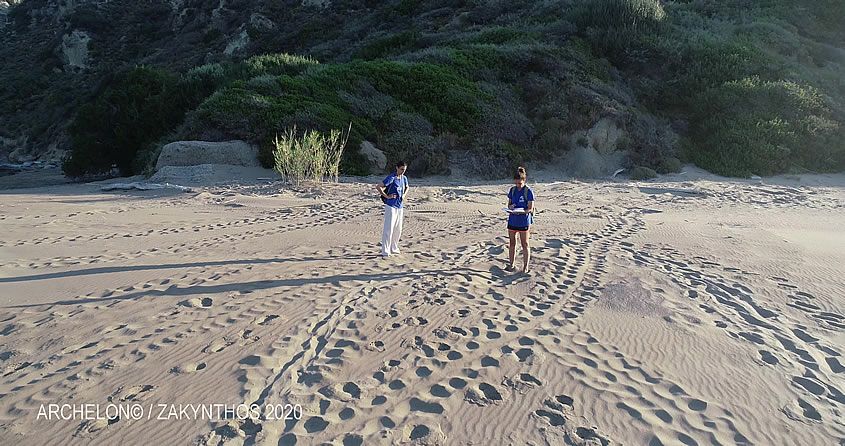
A- This year,ARCHELON researchers and volunteers have recorded over 1700 nests in Zakynthos, in collaboration with the National Marine Park, and in this respect, this year is the 3rd best year since 1984, when ARCHELON began to systematically record the nests. ARCHELON's long-term monitoring work has made clear that the number of nests fluctuates every year in Laganas Bay, Zakynthos, as is the case with most sea turtle populations in the world.
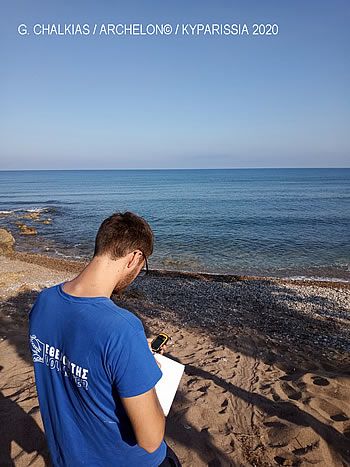
In Kyparissia Bay, ARCHELON recorded over 3500 nests at the core area of the nesting habitat, i.e. 9.5 km of beach from Kalo Nero to the estuary of Neda, more than any other year since 1984. Although there are annual fluctuations in this area as well, a significant upward trend in the number of nests has been recognized in the last decade.
Q- Can the observed increase in the number of nests recorded by ARCHELON in Zakynthos and in Kyparissia Bay be attributed to the lockdown?
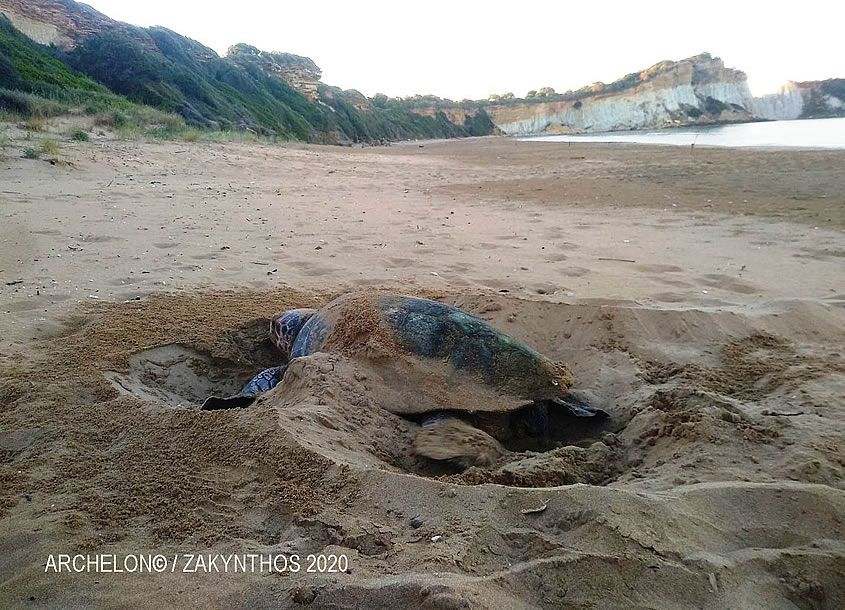
A- The number of nests recorded each year is mainly related to the number of female turtles that reach the nesting beach. Loggerheads nesting in Greece spend their time in their feeding grounds, located mainly in the Gulf of Gabes (North Africa) and the North Adriatic, and every 2-3 years they migrate to the nesting beaches to lay their eggs. Whether and when a female turtle is ready to migrate from its feeding grounds to the nesting beach, depends on various factors. The most important factor is good nutrition, i.e. the storage of sufficient fat that will help it withstand the high energy costs of migration and reproduction, which last from about February to August.
The lockdown and travel restrictions due to COVID-19 were implemented in Europe and around the world in the spring of 2020, i.e. when sea turtles in the Mediterranean had already begun their reproductive migration to the nesting beaches in Greece and elsewhere. It is therefore unlikely that the restrictive measures drove more turtles to carry out this migration as they could not obtain the required energy reserves in such a short time.
Q- Do you mean that the absence of people from the beaches had no effect on the nesting of sea turtles?
A- ARCHELON’s scientific publications and observations all these years have indicated that females avoid going ashore when there are lights, loud noises or umbrellas and sunbeds, and usually select another part of the beach, with less disturbance. For this reason, special measures are adopted in the National Marine Park of Zakynthos and in the Nature Protection Area of Kyparissia Bay. Although the rate of implementation of these measures is higher in the National Marine Park of Zakynthos, violations of the law occur frequently.
In this respect, the conditions for nesting were ideal until the end of June this year because there was almost zero disturbance to the turtles. Therefore, the turtles that had reached the nesting beaches could lay eggs undisturbed. From July onwards, umbrellas and sunbeds appeared in specific parts of the nesting beaches in all the areas monitored by ARCHELON, which makes nesting somewhat difficult.
In conclusion, this years’ absence of human disturbances from nesting beaches, eased the egg-laying of sea turtles but didn’t cause the observed increase of nest numbers, as claimed by several articles that appeared recently in the press and do not have any scientific basis.
Q- Do you expect that the low tourist activity from July onwards will favor a higher number of hatchlings this year?
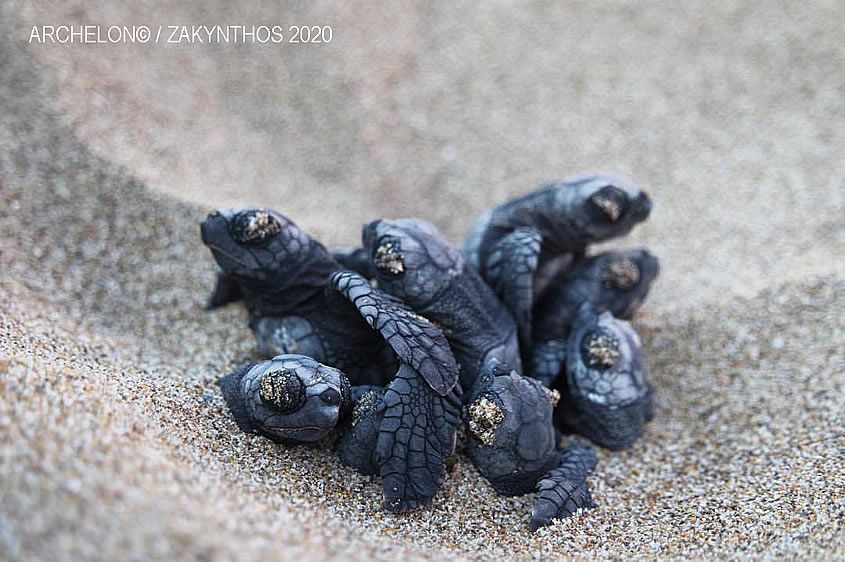
But hatchlings are met with another problem on their way to the sea, that of light pollution. In all nesting areas in Greece there are points or even entire beaches where a huge effort is made by ARCHELON researchers and volunteers in order to save the hatchlings that are disoriented by the lights. This year's low tourist activity does not necessarily mean that the lights on the nesting beaches will be reduced. ARCHELON has already appealed to residents, businesses and visitors in all nesting areas, to turn down or turn off the lights after 11 pm until the end of September. This is for us the simultaneous challenge and opportunity of the COVID 19 summer.
Information:
- Giannis Chalkias, ARCHELON’s project officer for west Peloponnese, tel.: 6932285817, email: westpelop@archelon.com
- Nikoletta Sidiropoulou, ARCHELON’s project officer for Zakynthos, tel.: 6982766371, email: zakynth@archelon.gr
Notes to editors :
ARCHELON The Sea Turtle Protection Society of Greece has been systematically monitoring and recording the reproductive activity of the loggerhead sea turtles in Laganas Bay in Zakynthos and Kyparissia Bay since 1984. Later, monitoring also began on the nesting beaches of Crete and southern Peloponnese (Lakonikos Bay, Romanos and Koroni). This has resulted in the development of one of the most comprehensive databases for the species in the world, which has helped us better understand the sea turtles’ biology and ecology in the Mediterranean.
See our recent post on the official ARCHELON facebook page with hatching s emerging from nest on Gerakas beach, Zakynthos: https://www.facebook.com/archelon.gr/videos/1952374221563053/
You can send your views and comments to: info@archelon.gr
Check out the scientific work of ARCHELON here: https://www.archelon.gr/eng/bibliography.php?mid=5&mid2=95
An unexpectedly high number of loggerhead nests in Greece and throughout the Mediterranean makes 2020 stand out as the Year of the Sea Turtle
ARCHELON has already recorded more than 3,500 loggerhead nests in the Nature Protection Area of Kyparissia bay this summer, but at the phase of hatching, the fate of many of them relies on locals and visitors
RECENT NEWS
- OUR NEWS01/10/2026
October for sea turtles: Help us care for our sea turtle patients this winter
This October, we are launching a fundraising campaign with one clear goal: to raise €5,000 to support the care of our sea turtle patients through the end of 2026.
- OUR NEWS25/09/2026
Together for Crete’s nesting beaches: "Turtle-Friendly Hotel" award ceremonies in Chania and Rethymno
ARCHELON hosted the award ceremonies for the new Turtle-Friendly Hotel certification, as part of the TUI Turtle Aid Greece program in Crete.
- OUR NEWS23/09/2026
We bade farewell to Omiros, the blind sea turtle that traveled from Greece to Cornwall
In September 2026 Omiros, a male Loggerhead sea turtle with a remarkable story, passed away. He had spent the last 16 years of his life at the Blue Reef Aquarium in Cornwall, having traveled there from Greece.
- OUR NEWS10/09/2026
Sea turtles kept in a restaurant tank in Chania: True love for nature begins with respect.
We all feel a sense of excitement when we encounter a wild animal up close. It is only natural to want to connect with nature, observe it and understand it better.
- OUR NEWS09/09/2026
Schools are back at ARCHELON! A new year full of learning and action
The new school year is beginning, and with it, the voices, questions, and excitement of thousands of students return to ARCHELON’s Sea Turtle Rescue Centre.
- OUR NEWS06/09/2026
Sea Turtle Hatchlings Captivated All Ages in Corfu
- OUR NEWS01/09/2026
Taking time off work to volunteer for the sea turtles in Greece: Amy’s month with ARCHELON in southern Peloponnese
When Amy Carey was 10 years old, she came face to face with a sea turtle while on holiday in Greece. Decades later, at 47, she decided it was time to turn that childhood memory into reality.
- OUR NEWS13/08/2026
Hatchlings need help in September and October: Special volunteer offer for 2 weeks!
In order to protect the nests and the last hatchlings of this year, we need the help of more volunteers!
- OUR NEWS10/08/2026
One beach party canceled, 66 nests saved in Chania!
A significant victory for the protection of sea turtles in Chania, thanks to the direct cooperation of ARCHELON and NECCA.
- OUR NEWS07/08/2026
Sea turtles of the Saronic Gulf: Why feeding them is not an act of love
The Municipality of Saronikos and ARCHELON are campaigning for the safe and proper coexistence of bathers and wildlife.
- OUR NEWS05/08/2026
Greek fishermen release rare Leatherback Turtle in the North Aegean!
In mid-July, we received a video of an impressive sea turtle that had been caught in the nets of a fishing boat.
- OUR NEWS30/07/2026
Join our Sea Turtle Nest Excavations in Peloponnese and Crete
ARCHELON invites you to a unique experience of environmental education and scientific observation!
- OUR NEWS20/07/2026
43 Years of Tagging Sea Turtles in Greece Reveal Their Journeys in the Mediterranean
A new scientific publication highlights the important marine areas turtles use in the Mediterranean, through ARCHELON’s tagging program in Zakynthos, Kyparissia Bay and Rethymno.
- OUR NEWS17/07/2026
The first hatchlings of 2026 in Zakynthos!
The first nest hatched on Dafni beach in Laganas Bay in Zakynthos. Our team discovered the tiny tracks in the early hours of Tuesday, July 14th.
- OUR NEWS15/07/2026
A rare giant of the Greek seas: What our new study reveals about the Leatherback turtle
A new scientific publication brings together for the first time all available records of the Leatherback sea turtle (Dermochelys coriacea) in Greek waters.